
The Meaning Behind Maduro’s Capture: Why Trump’s Move Goes Far Beyond Venezuela

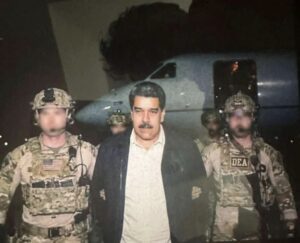
Screenshot
by Marco Vicenzino
3 January 2026
The capture of Venezuela’s Nicolás Maduro and his transfer to New York to face U.S. indictment mark more than a dramatic escalation in bilateral relations. They signal a broader recalibration of U.S. deterrence in the Western Hemisphere, with implications that extend far beyond the Americas and into an increasingly contested new world order.
Trump’s move against Maduro involves multiple motivations, including economic and legal considerations. Above all, however, it is geopolitical. It reflects the realities of a new National Security Strategy and an emerging Trump doctrine—and sends a clear message to domestic, regional, and global audiences that U.S. red lines are being redrawn.
What Donald Trump is signaling is not a Venezuela policy in isolation, but a reassertion of U.S. strategic intent in its near abroad—and beyond where core interests are at stake.
From the administration’s perspective, after years in which hemispheric instability was managed, compartmentalized, or quietly tolerated, Washington is making clear that the Western Hemisphere is once again central to U.S. strategy—not a permissive space for drift, criminalized governance, or unchecked external power projection.
At the core of this approach is a redefinition of boundaries. Latin America is being told that sovereignty will no longer shield regimes that fuse state power with transnational crime, narcotics trafficking, and illicit finance. By foregrounding indictments and legal accountability, the United States is reframing geopolitics through enforcement and deterrence rather than diplomacy alone. Leaders who criminalize the state are being treated less as political counterparts than as security threats.
Trump’s target audience, however, extends well beyond Caracas. His message is calibrated for China, Russia, Iran, and other aspirants that have long treated Latin America as a low-risk arena for influence projection. This has been evident in Beijing’s economic penetration through debt, energy, and infrastructure; Moscow’s security ties and intelligence cooperation; and Iran’s logistical and security footprint in Venezuela and parts of the wider region. All have tested U.S. tolerance for years, operating on the assumption that the hemisphere was strategically secondary for Washington.
Maduro’s capture is intended to puncture that assumption. The signal is that proxy influence, grey-zone activity, and strategic freelancing in the Americas will now carry tangible costs.
Allies, too, are being addressed. Washington is signaling a renewed willingness to act without full consensus when it judges core interests to be at stake—moving first and managing diplomatic fallout later. This is a statement about decision-making as much as doctrine, and it marks a departure from a period in which caution often substituted for clarity.
Critics will argue that such actions risk eroding international law, inflaming regional opinion, and setting precedents others may exploit. They will warn that unilateral force, even when legally framed, can undermine norms the United States itself relies upon, and that escalation in the hemisphere may prove harder to contain. These concerns go to the heart of global order and U.S. credibility.
Yet to dismiss Trump’s gambit as a replay of past U.S. interventions is to miss the strategic distinction being drawn. This is not Iraq. It is not Afghanistan. It is not an open-ended project of occupation or nation-building. It is a deliberate—if controversial—attempt to restore deterrence in a region long treated as geopolitically settled.
Ultimately, this episode will be judged not only by the legality of the operation or the fate of one Venezuelan leader, but by what follows.
Deterrence succeeds only if paired with discipline, clarity, and restraint. Trump has made his intent unmistakable to those testing the United States in the Americas for years, including China, Russia, and Iran. Whether this recalibration restores stability—or invites escalation—will define hemispheric politics for the decade ahead and beyond.