
WHAT NEXT AFTER THE WAR?

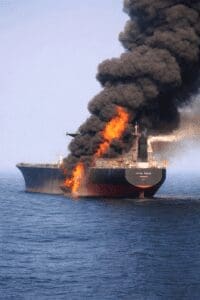
by Marco Vicenzino
2 April 2026
What comes after the war may prove more consequential than the war itself.
Even after major hostilities subside, the Gulf will not return to normal. Iran’s rump regime may use the Strait of Hormuz as a permanent instrument of leverage — locking the region into a new era of managed instability with global consequences.
In his recent address to the American people, U.S. President Donald Trump clarified one thing above all: Washington has still not defined a settled post-war order. He offered no fixed timetable for ending the conflict, kept open the possibility of further strikes if negotiations fail, and made clear that the military phase has not yet translated into a stable political end-state. Strategically, that matters. A war without a clearly articulated end-state rarely produces closure. More often, it produces a longer bargaining phase under the shadow of force.
That is why the greatest mistake after the cessation of major hostilities will be to assume that the war is over simply because the heaviest bombing has stopped. It will not be over. It will merely have entered a more durable and, in some ways, more dangerous phase.
The post-war Gulf will not be defined by restored equilibrium, but by a new status quo in which uncertainty itself becomes the central strategic fact. What may be coming is neither stable peace nor uninterrupted war, but something in between: a prolonged condition of managed instability in which escalation remains latent, coercion remains available, and instability continues to radiate outward into markets, energy flows and strategic calculations.
This conflict is best understood in stages: (1) the rupture of October 7; (2) the widening of conflict through proxies, militias and maritime disruption; (3) the shift from shadow war to direct Israel-Iran confrontation; (4) the phase of direct U.S.-Israeli military pressure on Iran and the weaponization of Hormuz; and, next, (5) a post-war phase centered on the rump regime.
That term matters. Iran is more likely to contract than to recover into normal statecraft. A rump regime is not a regime at ease. It is a regime in survival mode: smaller in confidence, harsher in instinct, narrower in legitimacy, and more dependent on coercive instruments than on political authority. In practical terms, that points to an even more security-centered system and a strategic culture shaped less by long-term statecraft than by permanent crisis management.
Such a regime does not need to win decisively in order to remain dangerous. It needs only to deny normality. And nowhere is that easier than in the Strait of Hormuz.
Hormuz may become the defining lever of the new status quo. The old assumption was that the Strait mattered mainly in moments of outright closure or major military crisis. That is now too narrow. The central post-war question is not whether Hormuz is formally open or formally closed. That binary is too crude. The more important question is whether the waterway becomes durably conditional: technically navigable, but politically shadowed; formally open, but strategically unsafe; usable, but only at a persistent premium. A chokepoint does not need to be fully sealed to exercise leverage. It only needs to remain sufficiently risky that every transit carries added cost, caution and uncertainty.
That may be the essence of the new Gulf order. Not permanent war. Not stable peace. But a condition in between. In that environment, the leverage of a weakened but still dangerous Iranian order lies not in permanently closing the strait, but in preserving a credible ability to interrupt, threaten, harass and selectively politicize passage. Shipping routes remain open, yet never fully normal. Energy flows continue, yet under political shadow.
This matters first and most for Gulf states. Even after the bombing pauses, the security problem will remain acute. The issue is not merely whether the Strait can be reopened in a formal sense, but whether the region enters a long period in which commercial life remains possible yet strategically conditional. In such an environment, shipping insurance is never purely commercial. Energy exports are never only about supply and demand. Investor confidence is shaped not only by physical security, but by the constant possibility of renewed harassment, sabotage or signaling.
But the consequences do not stop in the Gulf. Flows through Hormuz in 2024 and the first quarter of 2025 accounted for more than one-quarter of global seaborne oil trade and about one-fifth of global oil and petroleum product consumption. Around one-fifth of global LNG trade also moved through the Strait in 2024. Britain and Europe are unlikely to feel the next phase first through dramatic physical shortage. They are more likely to feel it through the repricing of risk: freight, insurance, fuel costs, inflation expectations and broader market volatility. Asia, too, will feel the consequences through growth, manufacturing and supply chains. In a fragmented, multicentric world, insecurity in Hormuz does not stay in Hormuz.
This is also why the next phase will test the posture of outside powers. The real question is whether external actors approach Hormuz chiefly as a theatre for continued pressure or as a system that must be stabilized. For Gulf states, that distinction matters enormously. A strategy centered only on coercion may extend uncertainty even when it succeeds tactically. A strategy centered on stabilization must still deter, but with a clearer view of maritime security, commercial continuity and strategic credibility.
Trump’s April 1 speech matters in precisely this respect. It did not describe a settled post-war framework. It described a continuing pressure architecture. If Washington remains in coercive bargaining mode while Tehran emerges from war more insecure and more hardline, then the incentives on both sides point not to restored equilibrium but to a more brittle interim order. The battlefield may quieten before the strategic contest does.
Nor is the likely danger confined to classic naval confrontation. The rump regime phase may be characterized by ambiguity: selective passage, deniable sabotage, harassment of commercial shipping, proxy activity, cyber pressure, legal and quasi-legal claims over transit, and periodic signaling designed to remind the world that the Strait remains contingent.
That is why the phrase “after the war” may prove misleading. It implies a clean dividing line between conflict and recovery. The Gulf is unlikely to offer one. What follows major hostilities may not look like war in its most dramatic form, but it may still function as a continuation of conflict by other means.
The post-war Gulf, then, should not be described as post-conflict. It should be understood as Stage 5 of a larger regional war: the stage of the rump regime and the new Hormuz order. The old status quo is gone. What comes next is a harsher equilibrium in which Iran’s rump regime survives not by restoring confidence, but by preserving uncertainty. The war may eventually subside. The new instability is far less likely to do so.