
In the AI Era, US-China Competition Hinges on Who Can Adapt Faster

South China Morning Post
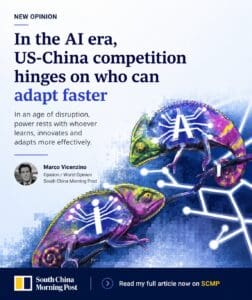
In the Al era, US-China competition hinges on who can adapt faster
In an age of disruption, power rests with whoever learns, innovates and adapts more effectively
Opinion by Marco Vicenzino
This article was originally published in the South China Morning Post on July 1, 2026.
https://www.scmp.com/opinion/world-opinion/article/3358763/ai-era-us-china-competition-hinges-who-can-adapt-faster
Power has historically been measured by indicators such as territory, population, industrial production, military capability and economic scale. Those foundations remain indispensable. But each technological revolution has changed the nature of geopolitical competition.
The Industrial Revolution rewarded manufacturing capacity. The 20th century rewarded industrial scale, military mobilisation and ideological reach. Globalisation rewarded efficiency, integration and financial connectivity. The emerging age of artificial intelligence (AI) rewards adaptive capacity.
AI compresses strategic time. Technological breakthroughs spread over years rather than decades. Supply chains reorganise more rapidly. Capital reallocates faster. Military innovation cycles shorten. Governments have less time to recognise strategic failure, and even less time to correct it.
The decisive advantage belongs not to those that possess the greatest resources, but to those that learn, innovate and adapt more effectively than their competitors. This is how the strategic competition between the United States and China should be understood.
As the US reaches its 250th anniversary, many frame the future as one defined by American decline and Chinese ascent. Across Asia, that assumption shapes defence and economic policy decisions, as well as long-term strategic alignment.
However, great powers don’t necessarily lose their position because of a stronger rival. They weaken due to domestic institutions struggling to adapt as international ambitions keep expanding. Strategic overextension begins not overseas, but at home when national capacity lags behind national ambition.
The critical question is, therefore, no longer which country appears stronger but who is likely to prove more resilient. Military capability remains indispensable, as does technological leadership, industrial production and economic output. Yet each ultimately depends upon deeper foundations: educational excellence, scientific research, energy security, infrastructure, institutional effectiveness and the capacity to translate national resources into sustained strategic advantage.
Every successful grand strategy begins with domestic renewal. After the Cold War, the US benefited from an international system in which its military superiority, financial influence and technological leadership appeared largely uncontested. Those conditions encouraged the assumption that global leadership could be sustained without continual investment in domestic sources of strength.
However, today’s competition extends beyond military spending or deployments. It encompasses semiconductors, AI, advanced manufacturing, critical minerals, scientific research, education, fiscal sustainability and the ability to mobilise resources over decades rather than election cycles.
The contest between Washington and Beijing is not merely one between two states. It is a competition between two models of national organisation.
Historically, the US distinguished itself not because it avoided crises, but because its constitutional order enabled renewal. It endured civil war, economic depression, global conflict, financial crises and profound political division. While progress has often been incomplete, its institutions have shown capacity for correction without systemic collapse.
That doesn’t indicate perfection, but it does represent a strategic asset for the key question confronting the US and China: how to renew power as technological and geopolitical change continues to accelerate.
For the US, this presents an opportunity and a challenge. America’s greatest strategic advantage has rested upon an ecosystem capable of generating renewal: world-class universities, scientific research, entrepreneurial culture, deep capital markets, technological innovation and an enduring ability to attract talented people from around the world. Maintaining that ecosystem matters more than any defence posture or diplomatic initiative.
Fiscal sustainability, educational excellence, infrastructure, technological leadership, energy security and institutional effectiveness are more than domestic policy priorities. They are strategic assets. A nation without these foundations gradually narrows its options abroad. Domestic renewal is an essential component of grand strategy.
China faces a different, equally consequential, strategic test. Its remarkable rise has shown how a centralised system can mobilise capital, coordinate industrial policy, develop infrastructure and compress decades of economic progress into a single generation. Few countries have transformed their national capabilities as rapidly or on such a scale.
The next phase of competition, however, may reward a different capability. As technological disruption accelerates and demographic pressures intensify, strategic success will depend not only upon executing long-term plans, but upon adapting those plans when circumstances change faster than institutions were designed to anticipate.
History suggests that every major power eventually confronts the same question: can its institutions continue learning after the conditions that produced earlier success begin to change?
Neither Washington nor Beijing can assume past performance guarantees future advantage. The international system is entering an era in which AI, demographic change, energy transition, technological competition and geopolitical rivalry are unfolding simultaneously and testing every political system.
For Asia, this distinction carries profound consequences. Governments recognise that the future is unlikely to be defined by a simple choice between American primacy and Chinese dominance. Their strategies reflect a more sophisticated reality. They seek economic engagement with China while strengthening security partnerships with the US, diversifying supply chains, expanding regional cooperation and preserving strategic flexibility.
Investment decisions, semiconductor ecosystems, energy security, digital infrastructure and advanced manufacturing increasingly depend not only upon market size or production costs, but upon judgments about long-term resilience. Governments and investors are asking which systems are most likely to remain adaptive in the era of disruption.
Military superiority, economic scale and technological leadership still matter. Yet none is self-sustaining. Each depends upon institutions capable of generating innovation, attracting talent, allocating capital effectively and renewing public confidence. Power continuously depreciates unless societies regenerate the foundations that created it.
This century’s defining geopolitical competition may ultimately be remembered less as a contest over which nation accumulated the greatest power than over which political system proved the most capable of continually renewing it.