
Why An Era of Managed Hormuz Disruption Would Not Bode Well for Asia

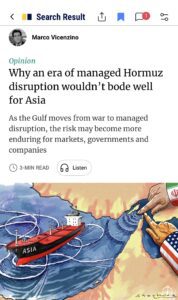
Screenshot
Why An Era of Managed Hormuz Disruption Would Not Bode Well for Asia
As the Gulf moves from war to managed disruption, the risk may become more enduring for markets, governments and companies
South China Morning Post
by Marco Vicenzino
29 April 202
Even if the immediate phase of conflict subsides, the Gulf is unlikely to return to the status quo. For Asia, the central question is no longer simply whether the Strait of Hormuz is open. It is whether the waterway remains reliable, predictable and politically insulated from coercion.
That distinction now matters more than ever. For China and other major Asian importers, it is a question of whether energy flows, shipping routes and sanctions exposure are increasingly being shaped by a crisis they do not control.
The current status of the Strait of Hormuz is best understood as an open-ended holding arrangement: contested in substance and vulnerable to change. The interruption of another planned round of US-Iran diplomacy only reinforces the point. Negotiations have not stopped, but they are moving in fits and starts, shaped by pressure, distrust and shifting calculations rather than by a clear route towards a settlement.
For Asia, this phase may prove more important than the fighting itself. The clearest sign is not diplomatic language but maritime traffic. The strait is open to some, yet traffic has remained well below normal levels. The issue is no longer legal access alone, but commercial confidence. A waterway can be open on paper while still failing to function as a stable artery of the global economy.
The danger is not necessarily another dramatic rupture of maritime transit. It could lie in a more durable situation where the strait remains formally open but strategically uncertain. Commercial movement may continue, but with thinner confidence, higher premiums and more political risk, meaning that every government must plan for renewed disruption.
This is the new Hormuz disorder. It is a condition short of full-scale war but still far from normal commerce. It is a coercive middle ground where access remains possible, but confidence is weakened. That is precisely why it matters so much for the Indo-Pacific. For Asian economies, prolonged uncertainty can be damaging even without a spectacular closure of the strait.
The next phase of the crisis is therefore less about battlefield outcomes and more about political behaviour after the fighting. Iran may not emerge stronger from this phase, but weakness does not make it harmless. A damaged leadership may become more dependent on coercive tools, not less. It may have fewer conventional options, but stronger incentives to preserve leverage wherever it can.
That is where the idea of a “rump regime” – a weakened leadership surviving through coercion rather than confidence – becomes important. Such a regime does not need to control the regional environment. It only needs to deny normality. The Strait of Hormuz gives it that opportunity. By keeping access to it politically conditional, Tehran can remind the world that even a weakened Iran retains the ability to impose costs far beyond its borders.
For Washington, this creates a dilemma. Continued pressure on Iran may be necessary to preserve deterrence and extract concessions. But pressure also risks prolonging the very uncertainty Asian economies want reduced. A strategy built around coercive leverage produces tactical gains while keeping the Persian Gulf commercially unstable.
Recent sanctions on Chinese-linked buyers and shippers of Iranian oil reinforce the point. The pressure campaign has not ended. It has shifted form. For Asia, and especially for China, the Strait of Hormuz is no longer only an energy security question. It is becoming part of a wider contest over sanctions, shipping, finance and the political control of supply chains.
For China, this creates a double exposure. It remains dependent on energy flows from the Persian Gulf, but it must also operate in a maritime and financial environment where the terms of access are increasingly shaped by US enforcement power.
That does not mean Beijing can easily replace Hormuz or ignore the Gulf. It means the cost of reliance is changing. The risk is no longer only whether oil moves through the strait, but whether the surrounding system of shipping, insurance, payments and sanctions remains predictable enough for Asian economies to plan around.
For Beijing, the calculation is therefore different. China wants de-escalation and continuity, not a region more openly managed by the American military. It wants the waterway reopened and stabilised, but not under conditions that deepen US strategic primacy. China is not merely exposed to the Strait of Hormuz. It is exposed to an emerging order shaped by US sanctions, naval pressure and diplomatic leverage.
For advanced industrial importers such as Japan and South Korea, the priority is predictability: stable energy flows, manageable inflation and reduced pressure on shipping, insurance and manufacturing inputs. For strategic hedgers such as India and much of Southeast Asia, the response is likely to be quieter but still significant: more contingency planning, more diversification and a stronger preference for stabilisation over confrontation.
The current status of the Strait of Hormuz stresses Asian markets. If safe passage depends on temporary understandings, naval pressure and political bargains, then the commercial foundation on which Asian energy planning has long rested is already less secure.
The Gulf may no longer be moving from war back to normality. It may be moving from open conflict into a more ambiguous system of managed disruption. That is a different kind of risk – less visible than active war, but more enduring for markets, governments and companies.
Asia is entering an era in which passage through the Strait of Hormuz may remain possible, but can no longer be assumed.